Saturday, April 12, 2014

Japan Survival Guide Part 3: Getting around Japan by Rail!

Sleeping on the train is common.


Whether you’re here to live, or here backpacking you are going to have to get from point A to point B somehow. I was considering doing a post all about transport in Japan and including driving, because for many people coming here to live and teach driving is an essential part of the day and it certainly has been for me in my time here, however I feel that’s a whole post on its own. So I’m concentrating on trains today, and am going to take a look at getting around and surviving the locals/subway trains in Tokyo as well.


Firstly let’s consider getting around Japan. There is no contest for the fastest, easiest and most comfortable way to get around Japan – it’s the Shinkansen. The Japanese invented the bullet train decades ago now, and today you can take trains that are allowed to travel up to 320km/h (although that are able to hit speeds more than 440 km/h) and feature very comfortable seats, and have people serving snacks and drinks. What more could you want?
The only issue is the cost. From my city, Ichinoseki, to Tokyo it’s around $130US one way, and the distance is around 450km. It takes a touch over two hours. If you can read Japanese then you’ll find it’s possible to find websites where you can get discounts if you book around a month in advance, but most foreigners living here, even if they have some Japanese do not have the required skills for that. The overnight bus is around half that, and JR (Japan Rail) run many buses themselves so you could look into that at main railways stations. However, it turns it into a nine-hour journey!

Then you have local trains. The same ticket was more like $90-$100 by the local trains. It takes ten hours and you have to change trains 8 or 9 times. So it’s not exactly desirable. However, for the backpacker and tourist there is the ‘Japan Rail Pass’. Similar to the Eurail Pass, you need to buy it before you come to Japan.


At less than $500 for a 2 week pass, it CAN represent great value. But not if you’re going to use it so much, then it might not be worth it. The more you travel, the better value it becomes of course, and if you take long journeys – say Hiroshima to Tokyo, then you’ve already spent nearly half its value on one trip. So think about it. Regardless of what train options you plan on taking, there is one website that is extremely useful for planning rail trtavel, finding the price and more and that is this one –


It’s in English and it will pretty much sort you out for any train journey in the country, even local lines and lines around Tokyo!

Even if you’re living, like I did, in far flung Iwate, odds are you are going to come to Tokyo once or twice, if not more often. Most backpackers and tourists to Japan are also likely to spend some time in Tokyo. The best, if not simplest, way to get around Tokyo is by the trains. The subway. Call it what you will the rail transport network in Tokyo is epic, covers so much of the place and even links Yokohama in less than thirty minutes. It’s above ground, below ground, it even includes a monorail for one line. Great? Absolutely! Easy?

Not so much.

Things you need to know about the Tokyo & Yokohama rail networks.
Busy Shibuya Station

Follow the signs to the different lines.

Actually, the same can be said for other major cities too, but none rival Tokyo in complexity and sheer busy-ness. Firstly, multiple companies run different train lines. Not such an issue for a single journey with no changes, but once you start changing trains, you may need to change companies and it’s not so obvious which lines are which companies to foreigners. This means you need a new ticket as well, plus when you arrive at the station you’re changing at, you will need to leave the ticketed area and find the entrance to the other line.
For example, JapanRail (JR) run different lines in Tokyo. If you go from one JR line to another at an interchange station, you won’t need to leave the ticketed area and your original ticket should be to your ultimate destination. If you have to change companies, though, to say Tokyo Metro (this is a collective of lines rather than a general term for using the Tokyo rail system, keep that in mind here because it can catch you out) then just buy a ticket to the interchange station, and when you change you find the Metro part of the station – which could be a bit of a walk depending, buy the ticket for the next stage of the journey there.


Simply, travelling on the Tokyo rail system requires a bit of thought. You’ll get to the ticketing machines and above will be a map of the connected networks. If you are lucky, it will have English as well as Japanese as the one in the photo does, but quite a few do not. The map will tell you the fare to the station you are heading too, you click that amount on the ticket machine screen, pay the money and take your ticket. The fares shown are from the station you are at before boarding. Also, if you have under-paid you won’t be let out the automatic gate. However, they have ‘fare-adjustment’ machines before you exit. Put the ticket in the machine, it will tell you what you need to pay, you pay it, you get a new ticket and are let out.


One way around ticketing issues is the Suica or Pasmo cards. They are cards you can buy for a small fee and you top them up – you must top up with multiples of 1000 yen. They are good for all lines in Tokyo and Yokohama. They are a touch on/touch off sort of deal.

Give yourself time to navigate the system. Some of the bigger stations are insanely busy at the right (or wrong) times of the day. That’s Tokyo Station, which is the biggest and busiest for sure, Shibuya can be really confusing, Ueno, Shinagawa also rate up there. The picture doesn’t show it, but at the wrong times Yokohama station can be crazy busy too. The stations are often linked to (walking) subway systems with loads of shops, or even large shopping malls. You go through a door and you are suddenly surrounded by jewellery. So I say again, give yourself time to work it all out. I’ve found that the rail system maps you can get don’t show the whole picture, include every line or explain the different companies and when you get to the station, even though you had it all planned, sometimes you need to rethink how you’re moving from A to B.

Despite all this, I love rail travel, and rail travel in Japan is pretty awesome! Thanks for reading, see you tomorrow with the final instalment of my thoughts on Culture Shock, and may the journey never end!

Don’t forget my ebook - Short Journeys: Japan

Friday, April 11, 2014

Yokohama's Cup Noodles Museum

Well, it's taken over 8 eights, but this is my 300th post here! Celebrate good times!

Come on!

Please?

Minato Mirai is the harbour area of Yokohama. It’s really the feature of this wonderful city, shiny and sleek built over a few small islands with a large mall and a wonderful walkway that you can take from Sakuragicho station. It’s not in the dead centre of Yokohama, but in a district which includes the Landmark Tower and the Nihon Maru boat, which doubles as a museum. It’s also right next to Queen’s Square, a great place for restaurants and shopping. The bay looked really beautiful day, a clear day with a top temperature in the mid to high teens.

The shopping mall is called World Porters, which I found a bit of a strange name. This shopping mall moves the bags of the world to their hotel rooms? Ahh well, English is often different when used by the Japanese. And what I came today to this area to see is indeed quintessentially modern Japanese. Because in this swish precinct is the Cup Noodles Museum! That is right, you have comprehended correctly, a museum devoted to the invention of the cup noodle.


The entrance hall is seriously grand. Check out the giant cup noodle above the automatic doors!

The inside of a cup noodle cup before water is added.
I’ve already blogged, some time ago now, about the Ramen museum, and it should be understood about Japanese culture – it’s very definitely a foodie culture. Sure, cup noodles and ramen are not really haute cuisine, but nevertheless it is hard to deny that they have really left their mark on the world.
For every invention, there is a creator, and just as much as the museum I devoted to cup noodles, and instant noodles, it is also devoted to the inventor of this culinary staple – Momofuku Ando. And there you had it – I had already learnt something new, the name of the person who invented instant noodles and then thought of putting them in a cup. And I learnt that he was Japanese as well! Not only that, I learnt that they come the way they do because they are cooked in all, extracting all the moisture from them.


These are life size cutouts. They compared Einstein and Madame Curie
to the guy who invented cup noodles!

I learnt a few other things too – the way they got the noodles in the cup – by turning the cup upside down! Well I didn’t know that. Turns out that’s considered pretty amazing too! Ok, it’s all a bit surreal I admit. The museum itself is very cool, although it uses a lot of red which was a bit much in the cinema where a 13 minute animated film told the audience about the invention of the cup noodle. Then on the 3rd floor people sat decorating and colouring in designs on the exterior of the cups. There were even cooking classes.
Then there are the cardboard cutouts of important people in history like Einstein and Edison and of course, Momofuku Ando is up there with them. Again surreal. But let’s be honest, as a seasoned traveller, museums get very ‘samey’ after a while, and as much as I like ancient pots and the like, a museum that’s a little bit quirky is not so bad.
Examples of cup noodles since 1958

So, get your instant noodle and Momofuku facts straight. 1958 – he invented instant ramen noodles. 1971, to appeal to the American market, he invented Cup Noodles. In fact, when he was 96 he invented noodles in a package that could be eaten in space. The guy loved to invent noodle-inspired products. And who amongst us HASN’T had instant noodles before? Sure, they aren’t the most healthy thing to put in your tummy, but they are cheap and convenient. Did you know the idea was conceived by Ando watching people line up for black market ramen in the years after the Second World War, at a time when much of Japan was starving? And now over 100,000 million cup noodles are consumed across the world every year?
This was the cinema. It was very red.

This is a display that I can not explain.

So if you’re in Yokohama why not come down to the Cup Noodles Museum? See the different packaging of different cup noodles over the years, and across the world. Learn about the man who made this all possible. Have your photograph taken next to a silver statue of the guy. Decorate your own cup noodle, learn how to cook cup noodles (most probably can manage that, I admit) and marvel at one of the more unique museums of the world.
Decorating your own cup noodle cup!

World Journeys. Inspiring and Informing!


May the journey never end!

Tuesday, April 08, 2014

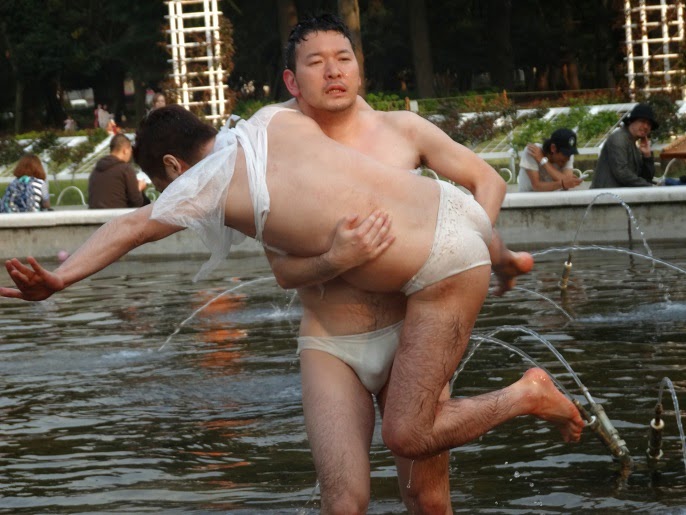
Harajuku and Naked, Wet Sumo in the Park

Today I had a great day. I did three main things - I caught up with two people who went through training with Interac when I first came to live in Japan. Ravi and Kamillah are from Jamaica and  great, friendly people and after two years, it was great to catch up. They have both spent the last two years close to Tokyo teaching English, whilst I was up in Iwate in 'the sticks' as we would call in it Australia. So they have had quite a different experience living and working in Japan to me. They are also going to feature on the podcast where I will be talking to them about life in Japan and their home of Jamaica too. The podcast should be starting very soon, before April 20th I have set my date to have it all sorted.


When I was previously in Tokyo, back in August 2012 I tried to find this special spot in Harajuku where the cosplayers came out to play. It would make a really good blog post with lots of photos, I thought. But I failed to find them. Today I tried again. I headed up to Harajuku from Shibuya and went down the famous Takeshita street. The man at the tourist information tram at Shibuya advised me this was the place to go.


Except, it wasn't. I walked the length of the street, and the closest I saw to cosplayers were girls dressed up in outfits to try and attract people in to the shops. It's certainly a colourful street I should add, where you can find some of the more daring of Harajuku fashion, but no cosplayers it seemed. The shops also employed a few people from Africa - Guinea-Conarky it turned out for the couple we spoke to, to entice the customers in. Spoke to a couple of guys from Guinea-Conarky about the cosplay and they told me it was in Yoyogi Park, mainly on the weekend, principally on Sunday.

Yoyogi Park

Okay. Well we headed to Yoyogi Park, which was five minutes walk away, to see if we could find any there on a Tuesday. The park was busy, as today it was lovely and warm and sunny and despite being a Tuesday the perfect day to head out. But we saw no cosplayers sadly. However, as we were leaving we did see something perhaps almost as amazing - two men, possibly drunk, in the pond wrestling each other! They had colour-co-ordinated underwear, and some sort of cloth over their chests, so maybe it was intentional. I don't know. It certainly was a very strange thing.


With a little time left in Japan, I am looking to find the odd and different. It certainly took away from the disappointment of not finding any cosplayers - I am not done with THAT mission either.

Thursday I will be continuing my Japan Survival Guide, I'm going to look at catching trains and transport.


Please note that slowly, but surely, I will be moving over to the Wordpress site, and this one will be phased out. It's a lot of work to repost the same thing on both sites. My Wordpress site has been a work in progress but it's starting to look like what I want it to now. Here it is -
worldjourneysdiscover.wordpress.com

Monday, April 07, 2014

The Frustrations of Self-Publishing

Hello all.
Today, please forgive me, I am going to be quite self indulgent. I will do my best to keep away from 'Oh woe's me!' and the like, but I can't make any firm promises.
So this self-publishing ebook lark. I started back in 2011 with no real idea what I was doing. I just got the first volume of Dhaka to Dakar out on kindle, and then wondered when someone was going to buy the thing. Forgot a bit about it as sales weren't forth coming and I was getting married and moving to Japan etc etc - life goes on.

2012 and I pressed on eventually with the second volume once settled here in Japan. I decided I could get SOMETHING out quicker if I released it chapter by chapter initially. And so I did that. And yes, I have a few more sales and I think it was a good idea simply because this way the titles were one-country specific, and not too broad. If someone was to search for a book, say, on Bosnia Herzegovina, my chapter on that might come up, and all the chapters were and are only 99 cents, aimed at actually making sales rather than money. And I continued on for the third book, Across Africa, which I think is easily the best of the three, the best written and the most interesting. And then combined them and put them out as volumes, and turned the first book Journey Through Asia into single chapter releases as well.

I mention the books in relevant blog posts, I hope I don't push too hard, and for a long while, apart from the very occasional facebook mention, that was all I was doing. As I was blogging very infrequently, that wasn't much in the way of publicity.

Last year in October I released Short Journeys: Ethiopia. I decided to do more writing, perhaps therapeutically more than anything else, but I included information on transport and accommodation as well as I continued the line with more Short Journeys, the most recent being Short Journeys: India.


Publicity


And this year I looked up the net for advice on how to publicise my ebooks. 2013 had a couple of good months, but to be honest I have never made more than 15 bucks in a month from my ebooks in total. So I read 'use twitter and social media', I found 'Goodreads' and have been listing my books there. When school finished I had a lot more time for this stuff, and I got into twitter, but I have to say - it's bloody exhausting! Publicising, listing in different places. As you know I've started publishing also with Payhip, which let's me keep 100% of the money made, and Lulu which doesn't, it keeps the first 99 cents as well, but it also put me on ibookstore, Nook and recently Kobo.


I made a page (and will make more) on Squidoo, my first was about India. I've connected with so many people in the last two weeks, primarily over twitter but tried to read as many blogs on travel as possible, like people's facebook pages if they like me back (I've had a lot of requests from people I started following, but any that didn't follow me back I can't even reply to!). I've thought about paying for campaigns but I'm not really sold on that. I joined tumbler but haven't started there as I don't really know what it's all about. I downloaded 'tweetdeck' (thanks to Dan Collins for that recommendation) so I could schedule tweets when I'm asleep and reach people awake on the other side of the world. I am living in Yokohama with no job other than this self publishing publicity lark (and writing) until May 9th when I return home to Australia and honestly, after just over a week here I'm a little crazy and bit depressed.

So where am I as of April 7th, 2014? How's it all going?


It's all, honestly, one big stressful ball of 'Argggggggghhhh!'.

Status of Payhip - around 6 weeks, with no sales. Maybe to be expected, it doesn't publicise your book at all and you publish in the rather boring PDF format.

Lulu. This picture says it all. I've link numerous times to Lulu and chatted about it here. I was very excited after my first sale, which took about five weeks. The graph went up. But now it's back down again. Second sale... where are you?


As for Amazon. Well, this year had been building very steadily, since December really. A few more sales each month. March I started to get into Twitter as I said. March turned out to be the best month ever in terms of total sales, I was really happy. Especially with Short Journeys. Short Journeys: Ethiopia has been the most successful book every month since it was published bar the first one I think.

A is for Amazon. But it is also for April. And despite the best of my publicity efforts, it's a week in and it's a shocker. TWO sales in a week. I've met my target 3 months running, but boy it's going to be hard with this start in April. I'm not sure what's happened. Have I over publicised? Have I reached everyone who was ever likely to buy the books in the first place? Who knows...

Reviews

One thing that's frustrating is getting reviews. I have two reviews for the Kazakhstan book, one for the Cameroon book, one for Dhaka to Dakar Book One: Journey Through Asia, and one each for the Bangladesh and Burkina Faso chapters, and that's it. All the reviews have been very positive thankfully. So, dear reader, I would ask that if you have read any of my books, and you don't mind, please do submit a review to Amazon or Goodreads, or even Lulu. They don't have to be more than a couple of sentences, and please... be kind!

I had no idea that this review existed for six months on Amazon for my Burkina Faso chapter of Dhaka to Dakar, it's really very kind.

Most Helpful Customer Reviews
5.0 out of 5 stars Excellent travel journal account of Burkina Faso September 1, 2013
Format:Kindle Edition|Amazon Verified Purchase
I really enjoyed this book, especially given its modest cost and production efforts. The photos are great and were easy to view in my Kindle Paperwhite. The author has an engaging writing style. I was trying to do some research on Burkina Faso as a country for human rights reporting purposes. This book gave me a very good anecdotal coverage of the people and countryside. I was especially intrigued to hear of the author's ability to use Internet cafes everywhere he went, which helped me establish in my human rights reporting that Internet access is possible in the country, even if it is one of the poorest and most technology-challenged countries in the world.

Thanks for your time today in my little self indulgence. Three places you can find my books -

Andrew Boland at Goodreads
Links to Amazon, every book listed, some videos also linked to certain books.

Andrew Boland at Amazon - Author page
All my books are released on Amazon first.

Andrew Boland at Lulu - Author Spotlight

Normal service will resume shortly! May the journey never end.


Sunday, April 06, 2014

Culture Shock Part Two: First Experiences in West Africa

Grim reality of Accra
When I went to India, I was a very green traveller. It was my first solo trip, the first time I had travelled alone. When I went to West Africa in 2006, I couldn’t claim the same. I had been to India three times, I had visited Bangladesh twice and been through Pakistan and Iran to get to Europe by land. So, I felt I had the necessary experience to deal with whatever Africa could throw at me.
I was wrong. I arrived in Accra, Ghana, with the plan to make it overland via a number of countries to Senegal. I planned to go through Togo, Benin, Niger, Burkina Faso and Mali on the way. But I was to immediately face culture shock in Accra, and the plans would flux and change and revert back to the original whilst I was in West Africa in 2006.
I was immediately struck with culture shock. In fact, on my way to Ghana I had already felt misgivings about going to this part of the world. Strange perhaps, because I had spent years researching and planning and imagining the good and the bad, the challenges and the adventures I would face there. I was, admittedly, worried that my peanut allergy was going to be a big problem, it’s a common ingredient in cooking in West Africa, but I had learnt how to deal with it by then. Or so I thought.
Life in Accra
When I arrived at Accra airport, I was a little surprised that despite an extremely long runway, the airport was very small. I was in sub-Saharan Africa for the first time! I flipped from panicky to excited and back again. I took a taxi into town, and with a little time, he found the Date Hotel. This place was a bit of an institution in Accra, there aren’t that many budget options so here was a place for less than 20 bucks and I took a room there.
Whilst the staff were really friendly, and the outdoor bar was nice, the rooms were poor to say the least. I was sharing with mice, the bathrooms barely functioned and the fans were loud. For a night or two it was ok, but I was there for quite a while.
Room at the Date hotel
The atmosphere in coastal Ghana is a little oppressive thanks to the humidity. It was well into the 90s (percent) and so very difficult to deal with, and for the first week or two I panicked at pretty much every meal I had worried that there might be peanuts inside. I was not coping well. I couldn’t get a handle on Accra – the way it was laid out, where I was, it seemed to be really big but flat. On top of that the only foreigners at my hotel were aid workers, and they were all too happy to pay for Nigerian hookers who were also staying at the hotel.
And the hookers were nice really, to chat with. And I should have expected something along those lines but well, it was all new to me and combined with quite a bit of poverty in parts, and the madness of the place (despite not being anywhere near as mad as India), and the fact that I felt completely on my own – no other backpackers around that I could see, well this flipped me out somewhat and I spent a couple of days with no-one to talk to much and certain that I was way out of my depth.
Cape Coast.

I eventually, after four days, moved on to Cape Coast, a quite pretty town down the… coast. I arrived at a cheaper, nicer, far cleaner guesthouse, and met a Canadian who on the spot was happy to see a backpacker and invited me that day to join her and her mother going to some tree houses in the jungle. I was very happy suddenly, I felt things were on the turn. I accepted, only for an hour or less later to be told that the mother had vetoed the idea as she wanted to spend alone time with her daughter. Well, feelings reversed again.
I tried to enjoy my time at Cape Coast, but I couldn’t connect to the other couple of backpackers. I went back to Accra, deciding possibly to skip Benin, Togo and Niger and go to Burkina Faso through to Mali and Senegal, quickly to, and get out to the UK where I was headed next. BUT back in Accra I met an Australian and we hung out for a couple of days. We saw the museum and a few other things around Accra, and like that, suddenly things were not so bad.
Market in Niamey, Niger.
Kindness in Miger.
He had been to the three countries I was considering cutting from the itinerary and in the end I decided to go there – I had a visa that covered them all anyway. And I moved on to Togo, which was strange, and Benin which was good although I had a bad moment where I lost it. Niger was again confronting with extreme, in your face poverty, but that was balanced by meeting a local with very little that offered me a bed for couple of nights. A warm and generous soul. I never forget these people. I had bought an electric stove because I wanted to cook to get around my peanuts fear, but then never used it. I gave it to this kind man.
Then, Burkina Faso. I had slept a night outside at a bus station in Niger as the buses leave at around 4am for longer distances, and to be honest it was fine if not a sensible thing to do. The bus took me to the capital of Burkina Faso, Ouagadougou. At the guesthouse there I met some backpackers and we had a fun day around the town, and when I moved on to Banfora, well, I was feeling finally that I had conquered my misgivings about the place.
Happy times in Ouagadougou.
So then I caught malaria. Well, probably from a bite I received sleeping outside at the bus station in Niger to be honest. It takes a little time to manifest. Then the doctor gave me Larium, which induced panic attacks. I was suddenly in hell. The initial treatment did not cure the malaria either. I had a guy in Banfora who took me on a tour around to see things who kept turning up at my hotel asking me for money, and eventually I left Banfora, still sick and panicky, to get away from him.
I still remember when the malaria came on. I was hanging with a couple from the Czech Republic. We watched a drum performance which was really cool and I felt very happy about that. I was really digging Burkina Faso. We went out for dinner and I had a really nice steak. Then to an outdoor restaurant/bar and were sitting around a table having a beer and I started coughing. Very quickly I had a temperature and in the space of 30-60 minutes I felt really sick. I went to hospital and was diagnosed with malaria.
Drumming performance in Banfora.
The hospital provided its own culture shock. Just a flat bed, not sheets, no nurses, and a doctor who couldn’t find my veins. He used a plastic glove and wrapped it around my arm, and then got the other patient in the room to assist. The toilet was locked at night and I had to drag my drip and myself outside to piss on the wall. To say it was basic is an understatement, but they did have clean needles and the medication which is something, right?
I spiralled from there, still sick I went to Bobo-Dioulosso. I got angry and stressed when suddenly I couldn’t change money at a bank. It can be difficult in some places in West Africa, they ask for receipts and other things. In Ouagadougou again I was taken to another hospital which dealt with westerners thanks to a kind soul I met on the bus, and there I received, finally, proper treatment.
This trip to West Africa ended in ignominy, and I returned home to Australia in my only aborted trip. Was that all ‘culture shock’, no certainly not. Some of it was bad luck, much was in my own mind but I did learn that you have to be in the right mental place to travel, especially if you are going somewhere special. I would returned to the region in 2007 and see Mali and Senegal, I went with a friend this time – a very good idea if you go to Africa. Do it with a friend, it really does help.

For more on my time in West Africa, the third book to the Dhaka to Dakar adventure covers Ghana, Togo, Benin, Niger, Burkina Faso, Mali and Senegal. It’s available on Kindle.


Next Sunday I will talk more in Part Three of ‘Culture Shock’!

May the journey never end! 

Saturday, April 05, 2014

Cherry Blossoms by Night

Well, Spring is everywhere at the moment even if it did rain for all of Thursday, and in Japan that means cherry blossoms - Sakura. People are out and about celebrating the arrival of spring with 'Hanami', hard to define, a sort of celebration though. After a long, cold winter, where even Yokohama saw some snow, the white and pink flowers are out on the trees and Spring is definitely in the air.


I must admit, I feel that Japanese people are just a little too obsessed with the cherry blossoms. There's no product that isn't more marketable with 'Sakura' in the title. It's a common girl's name. Advertising uses the cherry blossom image a lot. Lots of manga incorporates it. But for Hanami, it is celebrated by people going out at night with night stalls set up selling all kinds of food, games for the kids like ring-toss and shooting-parlour games, and small tents that double as bars. Here are some of the photos I took last night when out not too far from central Yokohama.


I was hoping to sit down and eat and drink, but the consensus appeared to be that we would drink, eat and walk which wasn't quite so easy. Still it made for a very pleasant evening out. But I started to realise that when you are with the in-laws you don't get the chance to sit back and enjoy at the pace you'd like to. It's nobody's fault, they are busy, there's work after all and dinner to prepare and all that. Still, it would have been nice to grab a chair and chat and meet some people.


But you know, such is life as a great Aussie once said. Thanks for reading everyone today - tomorrow I will be back on the culture shock bandwagon as it were talking about my experiences dealing with it in West Africa. Until then, may the journey never end!
(Yes, I have a catchphrase now!)

Boo! Here's a friend I made.

Catching fish to the joy of the kids!


Friday, April 04, 2014

Astounding Uzbekistan and a Video Date with Andy


As followers of this blog will know, I am darned keen on travel. I love to write as well, but also, I love to make short films and the like.
Along with my (blush) Doctor Who fanfiction stuff, I also have a channel called 'The Greater World' on youtube which has 13 travel videos on it at the moment. The latest travel video I created put together nearly 2 hours of footage I took in 2011 when I was in Uzbekistan.
I had a serious overland trip from Bishkek to Tashkent in one day, which took me through Kazakhstan and I wanted to capture that experience in my video. From different marshrutka to different marshrutka travel in Central Asia can be fun, and it is always an adventure. Join me as I visit the ancient Silk Road cities of Bukhara and Samarkand and see some of the world's most amazing Islamic architecture. This is a really interesting video... I hope!

For more information on Uzbekistan my Short journeys: Kyrgyzstan and Uzbekistan is full of stories and facts! Not to mention, travel tips and photos!


Yesterday I completed a short introductory video about my self published books. I've been doing some research on how to get more sales, and one advice people gave on forums and articles and the like was to have a short video speaking about your writings. So I thought I would give it a go. I recorded a couple of days ago, but was unhappy so I did it all again. I'm not really sure how useful it will be. I've put it on my youtube channel and added it to my author pages on Lulu and Amazon. Please take a gander!


Today I am heading into Yokohama to sample the Cup Noodle Museum, and might be seeing some cherry blossoms in the evening if the weather holds out for me, so stay tuned for that blog... tomorrow!