Folks, I love blogger. It's a great, easy to use platform, so many great blogs around, but the time has sadly come to fully move my blog over to Wordpress. It takes longer than I thought to post everything twice, and so from now on I will only be blogging on Wordpress - aiming for 5 posts a week. You can subscribe by RSS, Email or through Wordpress, so there's three ways to make sure you don't miss a post!
Here is the World Journeys home -
http://worldjourneysdiscover.wordpress.com/
And here are some of the latest blog posts you may have missed -
A Day in Hakone
Sunday Spotlight - York
Japan Survival Guide Part Five - The Classroom
My Travel Bucket List
Please do continue to follow me at my new home!
May the journey never end!
Showing posts with label World Journeys. Show all posts
Showing posts with label World Journeys. Show all posts
Tuesday, April 29, 2014

Saturday, April 19, 2014
Japan Survival Guide Point 4 – Food and grocery shopping.
So, you’re coming to live in Japan. You’re going to teach
English probably, and you’ll have your own apartment and quite often you’ll be
cooking for yourself. What’s that like? What is Japanese food like and what are
my choices when I eat out?
 |
| Shopping in Yokohama for food. |
These are all important questions. Let’s start with
self-catering and seamlessly melt into eating out via the convenience store, a
big part in the lives of people in Japan, foreigners and Japanese. The first
question you may have is – ‘Are supermarkets significantly different to those
at home?’
Well, yes, and no. Firstly, fruit and vegetables are very
seasonal here. I come from Australia, and things are not so seasonal at home
because of our mild to non-existent winters. In Japan there’s plenty of snow,
so that affects produce. Also, there simply isn’t that much land here to farm,
and so much of that land is used for, you guessed it, rice.
We studied chapters at school which talked about Japan’s
importing of food, and there’s so much that is imported. A high percentage of
the beef and meat comes from other countries, including Australia. They like to
marble the beef with strains of fat, so lean beef is not so easy to find.
That’s the way they like it here. You will also find that meat is often sold in
small, thin ‘strips’, rather than fillets.
There are a lot of noodle products, usually plenty of
vegetables with an unhealthy obsession with radishes. Vegetables, I feel, are
pretty expensive, especially in winter. A tomato could cost you $1.50 or more
for one, and they tend to price per unit, not by weight although that is not
always true. There are plenty of chips on the shelves and it’s often hard to
know what flavour they are by the packet.
Lots of ice cream too, and you’ll find green tea is a very
popular flavour here for it. And many other things as well. Ham and cheese
especially are disappointing for quality and choice. Sausages are hard to find,
unless you are looking for wieners. Self-raising flour is very rare. Bread is
ALWAYS sold as a half loaf, is usually white and sweet and cut into very thick
pieces. 1.5 cm is pretty standard and it gets thicker from there. That’s why I
have made my own bread for two years in Japan, I want it cut thinner, I want it
brown and with less sugar and chemicals. You can leave you bread in the fridge
for weeks here and it doesn’t change. Yes, bread is disappointing. I HAVE seen
bread as thick as an INCH.
I could go on but you get the idea. Then you get home and
most houses, apartments and whatnot don’t have an oven, just a stove. And that
usually doesn’t come with your apartment, so you end up renting or buying a one
burner stove and that’s what you cook with. So no baking for you! Or roasting.
Keep that in mind when you try to whip things up of an evening. Also, I find
prices more expensive here in Yokohama than I did in Iwate which makes little
sense, unless it’s sales tax.

If you’re in a rush, you can do what everyone does and
that’s go to a convenience store, or as they call it here, a ‘conbini’. 7/11,
Lawson, Family Mart, Sun K us… there are a legion of them here, I have never
seen so many. They carry bentos (a kind of prepared lunch pack), sandwiches
(not advised, will send you to the loo!), hot dogs, some very nice fried
chicken, hot pockets, chips… for a few dollars you can sort a meal out for
yourself with a bit of variety. Of course, it’s unlikely to score well in being
healthy. But this is what a lot of Japanese people do and they love their
conbinis very much.
Then you could go to a restaurant. And truly, of course you
must try some Japanese food whilst you’re here. Here are some examples.

Sushi – you know sushi and sashimi right? A sort of rice
ball or tube with raw fish, or vegetables, or egg or maybe something else on
top or inside? You’ll find them at supermarkets, conbinis and restaurants and
they are actually pretty healthy.

Okonomiyaki – well this one is a sort of omelette thing I
guess. It involves egg, cabbage and a mixture of various other vegetables,
often sprouts, a bit of meat maybe, restaurants specialise in this one. You can
often make it yourself with a little hot plate included on your table! Cook it
yourself and then smother it in ketchup, mayo or brown sauce. It ends up not
being really healthy, and I don’t much go in for it, but many love it.
Yaki-soba – can be really delicious. It’s a sort of noodle
thing mixed with cabbage, pork (or some other meat) and other vegetables.
Really really nice! My favourite Japanese food.

Natto – this one is more for the brave I think. Strong
smelling beans in a sort of sauce served usually with rice. It hails from Iwate
I believe, and to be honest is not my cup of tea. But it might be yours!
Ramen – and if none of these appeal to you, try a bowl of
ramen noodles. I like it with pork slices on top, the ramen noodles are in a
delicious soup with vegetables too.

Tempura – well tempura can be many things from chicken to
vegetables to shrimp. It’s basically just a Japanese take on covering something
in batter and frying it. And yes it can be pretty darned tasty, and no, it’s
usually not healthy.
You might also want to try –
Yakitori – grilled chicken on a stick in a sauce, really
nice.
Onigiri (Rice balls) – People here LOVE rice balls for lunch
or snack, usually wrapped in seaweed. Me? Not so much.
Soba, udon – more interesting kinds of noodles. There are
many!
Curry & Rice – known more simply as Curry Rice, it’s
usually a curry with maybe a little potato or other vegetables, and rice. It’s
very popular up in Iwate, tastes okay and is usually not particularly hot.
So there are a few quick ideas to start you off for eating
in Japan. Japanese cuisine is varied and usually tastes very strong, they don’t
like things mild here. Again, I have only touched the surface there are so many
different Japanese dishes. Be adventurous, but be aware you may end up with a
bowl of something you can’t stand! Japanese food is really a love or hate it
sort of deal.
Friday, April 18, 2014
An Evening in Shinagawa

If Shibuya is Tokyo being pretty darned trendy, Shinagawa is
Tokyo perhaps getting down to business. Well, my wife told me it was a business
district, although to me there seemed to be a few hotels and restaurants there.
It features the most impressive, in my opinion, of Tokyo’s stations. There’s a
big arched roof above a walkway that runs from the north to south exits that
people bustle through. That’s where you find the Japan Rail entrance to the
station. It’s a really big station too, one that’s pretty easy to get lost in.

I headed to Shinagawa yesterday evening to meet my wife and
some of her friends for dinner, and I was a bit early. So I thought I’d take a
stroll around and snap a couple of pictures. Pretty much attached to the
station was a Pachinko/slot place. They are unbelievably popular here. I once
wondered where the good people of Ichinoseki all were as the main streets were
often dead, and one day I went into a pachinko place and found 90% of the
machines taken and there were hundreds in that place, possibly over a thousand.
Almost definitely. And there are dozens in my old hometown.
Pachinko is almost a cross between a pinball game and a slot
(pokie) machine. You get a whole bunch of gold balls and try to guide them into
a winning position – the machine is upright though, and you have very little
control, much less than a pinball machine for example. Anyways, outside this
place there were two guys dressed up and dancing trying to get people to go
inside. They weren’t having much luck. I wonder if I could get a part time job
doing that?

 On the north side of the station, after passing people
walking through the arched walkway which was seriously grand, was the part of
Shinagawa I haven’t really explored at all. It seems a lot of restaurants are
in that area, 6-8 people were out hawking for their restaurants with menus in
hand and aprons on. Business men and women with stern faces took the escalators
up to the station on their ways home, and every now and again one person would
be smiling and laughing, relieving my worries that everyone in Tokyo is just
working until they die with no enjoyment from life whatsoever.
On the north side of the station, after passing people
walking through the arched walkway which was seriously grand, was the part of
Shinagawa I haven’t really explored at all. It seems a lot of restaurants are
in that area, 6-8 people were out hawking for their restaurants with menus in
hand and aprons on. Business men and women with stern faces took the escalators
up to the station on their ways home, and every now and again one person would
be smiling and laughing, relieving my worries that everyone in Tokyo is just
working until they die with no enjoyment from life whatsoever.
 |
| Inside the restaurant. |

It was very ‘colonial’ in design, reminding me of décor more
attuned to the 40s I guess, and somewhat reminiscent of a restaurant (also
French) I went to in Yaounde, capital of Cameroon. I really loved the look of
the place, although the waiter who served us, who was French, didn’t crack a
smile until the end of the night when we were paying the bill and I said to him
‘Please smile, you look so stressed’, and then he did. Which was a relief.
In fact this was the third French restaurant I have been to
inside a week! And no, I didn’t choose any of them! The menu was limited, but
we were in the lunch/bar area. It was great for my wife to catch up with her
friends, and I must remember what it’s like when we move back to Australia to
be at a table and understand less than 10% of the conversation. Although my
wife speaks a lot more English than I do Japanese, it will still be very hard
for her. Listening is always the hardest thing!
And so we walked back to Shinagawa station to take the train
back to Yokohama and beyond (we are in the suburbs here). The train was packed,
lots of standing, but apparently nothing like peak hour. Take care everyone,
more coming tomorrow. From now on on Sunday I will be posting a retrospective
on a place I visited in the past, in an attempt to not be posting everyday
about Japan.
Don’t forget to have a listen to the podcast. It’s the main
feature of yesterday’s blog. Each podcast will get its own dedicated blog post.
 |
| The station at night. |
Tomorrow it’s back to the Japan Survival Guide – I’m going
to talk about Japanese foods! And a little bit about grocery shopping! May the
journey never end!
Saturday, April 12, 2014
Japan Survival Guide Part 3: Getting around Japan by Rail!

 |
| Sleeping on the train is common. |
Firstly let’s consider getting around Japan. There is no
contest for the fastest, easiest and most comfortable way to get around Japan –
it’s the Shinkansen. The Japanese invented the bullet train decades ago now,
and today you can take trains that are allowed to travel up to 320km/h
(although that are able to hit speeds more than 440 km/h) and feature very
comfortable seats, and have people serving snacks and drinks. What more could
you want?

The only issue is the cost. From my city, Ichinoseki, to
Tokyo it’s around $130US one way, and the distance is around 450km. It takes a
touch over two hours. If you can read Japanese then you’ll find it’s possible
to find websites where you can get discounts if you book around a month in
advance, but most foreigners living here, even if they have some Japanese do
not have the required skills for that. The overnight bus is around half that,
and JR (Japan Rail) run many buses themselves so you could look into that at
main railways stations. However, it turns it into a nine-hour journey!

Then you have local trains. The same ticket was more like
$90-$100 by the local trains. It takes ten hours and you have to change trains
8 or 9 times. So it’s not exactly desirable. However, for the backpacker and
tourist there is the ‘Japan Rail Pass’. Similar to the Eurail Pass, you need to
buy it before you come to Japan.
At less than $500 for a 2 week pass, it CAN represent great
value. But not if you’re going to use it so much, then it might not be worth
it. The more you travel, the better value it becomes of course, and if you take
long journeys – say Hiroshima to Tokyo, then you’ve already spent nearly half
its value on one trip. So think about it. Regardless of what train options you
plan on taking, there is one website that is extremely useful for planning rail
trtavel, finding the price and more and that is this one –
It’s in English and it will pretty much sort you out for any
train journey in the country, even local lines and lines around Tokyo!
Even if you’re living, like I did, in far flung Iwate, odds
are you are going to come to Tokyo once or twice, if not more often. Most
backpackers and tourists to Japan are also likely to spend some time in Tokyo.
The best, if not simplest, way to get around Tokyo is by the trains. The
subway. Call it what you will the rail transport network in Tokyo is epic,
covers so much of the place and even links Yokohama in less than thirty
minutes. It’s above ground, below ground, it even includes a monorail for one
line. Great? Absolutely! Easy?
Not so much.
Things you need to know about the Tokyo & Yokohama rail
networks.
 |
| Busy Shibuya Station |
 |
| Follow the signs to the different lines. |
Actually, the same can be said for other major cities too,
but none rival Tokyo in complexity and sheer busy-ness. Firstly, multiple
companies run different train lines. Not such an issue for a single journey
with no changes, but once you start changing trains, you may need to change
companies and it’s not so obvious which lines are which companies to
foreigners. This means you need a new ticket as well, plus when you arrive at
the station you’re changing at, you will need to leave the ticketed area and
find the entrance to the other line.
For example, JapanRail (JR) run different lines in Tokyo. If
you go from one JR line to another at an interchange station, you won’t need to
leave the ticketed area and your original ticket should be to your ultimate
destination. If you have to change companies, though, to say Tokyo Metro (this
is a collective of lines rather than a general term for using the Tokyo rail
system, keep that in mind here because it can catch you out) then just buy a
ticket to the interchange station, and when you change you find the Metro part
of the station – which could be a bit of a walk depending, buy the ticket for
the next stage of the journey there.


Simply, travelling on the Tokyo rail system requires a bit
of thought. You’ll get to the ticketing machines and above will be a map of the
connected networks. If you are lucky, it will have English as well as Japanese
as the one in the photo does, but quite a few do not. The map will tell you the
fare to the station you are heading too, you click that amount on the ticket
machine screen, pay the money and take your ticket. The fares shown are from
the station you are at before boarding. Also, if you have under-paid you won’t
be let out the automatic gate. However, they have ‘fare-adjustment’ machines
before you exit. Put the ticket in the machine, it will tell you what you need
to pay, you pay it, you get a new ticket and are let out.

One way around ticketing issues is the Suica or Pasmo cards.
They are cards you can buy for a small fee and you top them up – you must top
up with multiples of 1000 yen. They are good for all lines in Tokyo and
Yokohama. They are a touch on/touch off sort of deal.

Give yourself time to navigate the system. Some of the
bigger stations are insanely busy at the right (or wrong) times of the day.
That’s Tokyo Station, which is the biggest and busiest for sure, Shibuya can be
really confusing, Ueno, Shinagawa also rate up there. The picture doesn’t show
it, but at the wrong times Yokohama station can be crazy busy too. The stations
are often linked to (walking) subway systems with loads of shops, or even large
shopping malls. You go through a door and you are suddenly surrounded by jewellery.
So I say again, give yourself time to work it all out. I’ve found that the rail
system maps you can get don’t show the whole picture, include every line or
explain the different companies and when you get to the station, even though
you had it all planned, sometimes you need to rethink how you’re moving from A
to B.
Despite all this, I love rail travel, and rail travel in
Japan is pretty awesome! Thanks for reading, see you tomorrow with the final instalment
of my thoughts on Culture Shock, and may the journey never end!
Don’t forget my ebook - Short
Journeys: Japan
Tuesday, April 08, 2014
Harajuku and Naked, Wet Sumo in the Park


When I was previously in Tokyo, back in August 2012 I tried to find this special spot in Harajuku where the cosplayers came out to play. It would make a really good blog post with lots of photos, I thought. But I failed to find them. Today I tried again. I headed up to Harajuku from Shibuya and went down the famous Takeshita street. The man at the tourist information tram at Shibuya advised me this was the place to go.

 |
| Yoyogi Park |
Okay. Well we headed to Yoyogi Park, which was five minutes walk away, to see if we could find any there on a Tuesday. The park was busy, as today it was lovely and warm and sunny and despite being a Tuesday the perfect day to head out. But we saw no cosplayers sadly. However, as we were leaving we did see something perhaps almost as amazing - two men, possibly drunk, in the pond wrestling each other! They had colour-co-ordinated underwear, and some sort of cloth over their chests, so maybe it was intentional. I don't know. It certainly was a very strange thing.


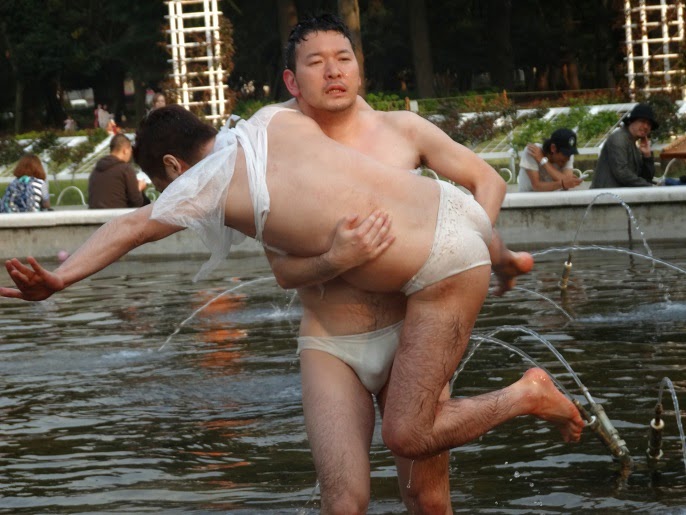
With a little time left in Japan, I am looking to find the odd and different. It certainly took away from the disappointment of not finding any cosplayers - I am not done with THAT mission either.
Thursday I will be continuing my Japan Survival Guide, I'm going to look at catching trains and transport.
Please note that slowly, but surely, I will be moving over to the Wordpress site, and this one will be phased out. It's a lot of work to repost the same thing on both sites. My Wordpress site has been a work in progress but it's starting to look like what I want it to now. Here it is -
worldjourneysdiscover.wordpress.com
Sunday, April 06, 2014
Culture Shock Part Two: First Experiences in West Africa
 |
| Grim reality of Accra |
When I went to India, I was a very green traveller. It was
my first solo trip, the first time I had travelled alone. When I went to West
Africa in 2006, I couldn’t claim the same. I had been to India three times, I
had visited Bangladesh twice and been through Pakistan and Iran to get to
Europe by land. So, I felt I had the necessary experience to deal with whatever
Africa could throw at me.
I was wrong. I arrived in Accra, Ghana, with the plan to
make it overland via a number of countries to Senegal. I planned to go through
Togo, Benin, Niger, Burkina Faso and Mali on the way. But I was to immediately
face culture shock in Accra, and the plans would flux and change and revert
back to the original whilst I was in West Africa in 2006.
I was immediately struck with culture shock. In fact, on my
way to Ghana I had already felt misgivings about going to this part of the
world. Strange perhaps, because I had spent years researching and planning and
imagining the good and the bad, the challenges and the adventures I would face
there. I was, admittedly, worried that my peanut allergy was going to be a big problem,
it’s a common ingredient in cooking in West Africa, but I had learnt how to
deal with it by then. Or so I thought.
 |
| Life in Accra |
When I arrived at Accra airport, I was a little surprised
that despite an extremely long runway, the airport was very small. I was in
sub-Saharan Africa for the first time! I flipped from panicky to excited and
back again. I took a taxi into town, and with a little time, he found the Date
Hotel. This place was a bit of an institution in Accra, there aren’t that many
budget options so here was a place for less than 20 bucks and I took a room
there.
Whilst the staff were really friendly, and the outdoor bar
was nice, the rooms were poor to say the least. I was sharing with mice, the
bathrooms barely functioned and the fans were loud. For a night or two it was
ok, but I was there for quite a while.
 |
| Room at the Date hotel |
The atmosphere in coastal Ghana is a little oppressive
thanks to the humidity. It was well into the 90s (percent) and so very
difficult to deal with, and for the first week or two I panicked at pretty much
every meal I had worried that there might be peanuts inside. I was not coping
well. I couldn’t get a handle on Accra – the way it was laid out, where I was,
it seemed to be really big but flat. On top of that the only foreigners at my
hotel were aid workers, and they were all too happy to pay for Nigerian hookers
who were also staying at the hotel.
And the hookers were nice really, to chat with. And I should
have expected something along those lines but well, it was all new to me and
combined with quite a bit of poverty in parts, and the madness of the place
(despite not being anywhere near as mad as India), and the fact that I felt
completely on my own – no other backpackers around that I could see, well this
flipped me out somewhat and I spent a couple of days with no-one to talk to
much and certain that I was way out of my depth.
 |
| Cape Coast. |
I eventually, after four days, moved on to Cape Coast, a
quite pretty town down the… coast. I arrived at a cheaper, nicer, far cleaner
guesthouse, and met a Canadian who on the spot was happy to see a backpacker
and invited me that day to join her and her mother going to some tree houses in
the jungle. I was very happy suddenly, I felt things were on the turn. I accepted,
only for an hour or less later to be told that the mother had vetoed the idea as
she wanted to spend alone time with her daughter. Well, feelings reversed
again.
I tried to enjoy my time at Cape Coast, but I couldn’t connect
to the other couple of backpackers. I went back to Accra, deciding possibly to
skip Benin, Togo and Niger and go to Burkina Faso through to Mali and Senegal,
quickly to, and get out to the UK where I was headed next. BUT back in Accra I
met an Australian and we hung out for a couple of days. We saw the museum and a
few other things around Accra, and like that, suddenly things were not so bad.
 |
| Market in Niamey, Niger. |
 |
| Kindness in Miger. |
He had been to the three countries I was considering cutting
from the itinerary and in the end I decided to go there – I had a visa that
covered them all anyway. And I moved on to Togo, which was strange, and Benin which
was good although I had a bad moment where I lost it. Niger was again
confronting with extreme, in your face poverty, but that was balanced by
meeting a local with very little that offered me a bed for couple of nights. A
warm and generous soul. I never forget these people. I had bought an electric
stove because I wanted to cook to get around my peanuts fear, but then never
used it. I gave it to this kind man.
Then, Burkina Faso. I had slept a night outside at a bus
station in Niger as the buses leave at around 4am for longer distances, and to
be honest it was fine if not a sensible thing to do. The bus took me to the
capital of Burkina Faso, Ouagadougou. At the guesthouse there I met some backpackers
and we had a fun day around the town, and when I moved on to Banfora, well, I
was feeling finally that I had conquered my misgivings about the place.
 |
| Happy times in Ouagadougou. |
So then I caught malaria. Well, probably from a bite I
received sleeping outside at the bus station in Niger to be honest. It takes a
little time to manifest. Then the doctor gave me Larium, which induced panic
attacks. I was suddenly in hell. The initial treatment did not cure the malaria
either. I had a guy in Banfora who took me on a tour around to see things who
kept turning up at my hotel asking me for money, and eventually I left Banfora,
still sick and panicky, to get away from him.
I still remember when the malaria came on. I was hanging
with a couple from the Czech Republic. We watched a drum performance which was
really cool and I felt very happy about that. I was really digging Burkina
Faso. We went out for dinner and I had a really nice steak. Then to an outdoor
restaurant/bar and were sitting around a table having a beer and I started
coughing. Very quickly I had a temperature and in the space of 30-60 minutes I
felt really sick. I went to hospital and was diagnosed with malaria.
 |
| Drumming performance in Banfora. |
The hospital provided its own culture shock. Just a flat
bed, not sheets, no nurses, and a doctor who couldn’t find my veins. He used a
plastic glove and wrapped it around my arm, and then got the other patient in
the room to assist. The toilet was locked at night and I had to drag my drip
and myself outside to piss on the wall. To say it was basic is an
understatement, but they did have clean needles and the medication which is
something, right?
I spiralled from there, still sick I went to Bobo-Dioulosso.
I got angry and stressed when suddenly I couldn’t change money at a bank. It
can be difficult in some places in West Africa, they ask for receipts and other
things. In Ouagadougou again I was taken to another hospital which dealt with
westerners thanks to a kind soul I met on the bus, and there I received,
finally, proper treatment.
This trip to West Africa ended in ignominy, and I returned
home to Australia in my only aborted trip. Was that all ‘culture shock’, no
certainly not. Some of it was bad luck, much was in my own mind but I did learn
that you have to be in the right mental place to travel, especially if you are
going somewhere special. I would returned to the region in 2007 and see Mali
and Senegal, I went with a friend this time – a very good idea if you go to
Africa. Do it with a friend, it really does help.
For more on my time in West Africa, the third book to the
Dhaka to Dakar adventure covers Ghana, Togo, Benin, Niger, Burkina Faso, Mali
and Senegal. It’s available on Kindle.
Next Sunday I will talk more in Part Three of ‘Culture Shock’!
May the journey never end!
Wednesday, April 02, 2014
Short Journeys India and a travelling lesson from Jaipur
I've been very keen to get the latest 'Short Journeys' up on Amazon for kindle, and finally it has arrived! 'Short Journeys: India' is a collection of tips, information and some experiences too - stories and so forth, from my three trips to India. It covers Delhi (the good, the bad and the ugly), a bit of Rajasthan - Jaipur, Udaipur and Pushkar, it covers Punjab - Chandigarh, Jalandhar (great story) and Amritsar with the amazing Golden Temple, and then it covers Agra, Varanasi, Kolkata, Darjeeling, Mumbai and Goa. It talks about the places I stayed and how I got about. So if it interests you, it's just $1.39 at the US Store, 85p at the UK store and 99 Euro cents at the European stores!

Short Journeys: India (US Amazon)
Short Journeys: India (UK Amazon)
The overall product page is here.

From the book, here's an experience I had in Jaipur where things got a little hairy for a while :
Jaipur and I
Short Journeys: India (US Amazon)
Short Journeys: India (UK Amazon)
The overall product page is here.
From the book, here's an experience I had in Jaipur where things got a little hairy for a while :
Jaipur and I
Jaipur was a bit of an
awakening for me I guess as a backpacker. It all boils down to one strange day
that could have ended pretty badly for me but fortunately didn’t. At the Ever Green
there was a notice plastered on a wall in the restaurant advising people that
if someone should approach them asking them to buy gems and sell them overseas
for a small profit they should decline. I thought it was an interesting note as
I scoffed down my breakfast, but my main thought was basically ‘I wonder what
that’s about’.
Turned out I would
soon discover. I had seen a bit of the town on my first day in Jaipur, and on
my second I had a few things to do – principally to get an overnight train ticket
to my next destination, which was Udaipur, and to send a parcel home.
 |
| Lake near Jaipur. |
Getting the train
ticket was easy enough, although it was my first real experience of standing in
a queue to buy something in India. I stood back from the person in front of me,
relieved that there was only one person in the line between the ticket window
and myself, and from nowhere as I stepped forward after they were done, a guy
basically ran in and pushed in when I was within half a step on the window!
I kid ye not – this
does happen in India. Regularly. You’ll have to decide how you want to deal
with it but when there are many people in a line it is just a huge group of
people jostling like a crowd. It’s not just India, but the sub-continent is
where it happens most and with the biggest numbers (although places in China
are pretty bad too). It’s a cultural thing really, perhaps a strange defence of
the behaviour, but with so many people it becomes a case of ‘if I don’t push
in, everyone else will and I will never get my ticket’. And that’s the long and
short of it. Play the game or don’t, it’s up to you. Just be aware that getting
angry and self-righteous never EVER won a fight in India.
So to be honest at
this point I was just ‘Ummm excuse me, but I was here first and you appear to,
probably by accident not realising someone was here and all, just jumped in
front and….’ or something to that effect. Or lack of. Yes, pretty poor form but
I was still the small fish in the big pond that is India and today I would have
pushed and glared. When I have stood up for myself, I seem to have been able to
out stare them and win the day.
Once I had my ticket
in the sleeper I headed to the nearby post office to ready my parcel and send
it home to Australia. Well, it was another chaotic scene in the post office
with crowds of people clamouring to get to the counter and I probably wasn’t
feeling all too keen to dive in. When I got the customs form I had to take it
away and write the details and then I would have to fight my way back to the
front to actually have the thing posted.
So I took the parcel
away to a bench where I started to fill out all the information. It wasn’t huge
but was a little bulky. A guy came up to me and offered to help, and I didn’t
have the smarts at this stage to say ‘I’m right thanks’. He helped me get a
really professional job done on the parcel, he took me to a counter where the
parcel was sewn into a hessian bag, and then was sealed with wax. The customs
form had to go to one window to be approved and then to another to post. He
managed to get it done very quickly as if my parcel was top priority.
I was very thankful to
be honest and in the end the parcel made it to Australia with no issues. He
then invited me to his house for a something to eat and I agreed and hopped on
a rickshaw. I was taken to a pretty nice house maybe fifteen minutes or so from
the station. I sat down outside in a courtyard area and chatted away to my new
friend and his pal about – well me mostly. They gave me a bottle of Coke and I
drank.
Somehow the
conversation turned to gems. They were mining gems. I had unwittingly told them
the next destination for me after India would be Europe. They started saying
that I could buy some gems from them at a very low price and then sell them
when I got to Europe and make a lot of money. Uh-oh… THAT was what the sign at
the hotel was going on about! So now I had to extricate myself from the
situation as best I could.
They were quite
insistent and turned a little aggressive. They were offering me an easy way to
make money so what was wrong with me not wanting to take a swag of gems with me
to Europe to sell? I just kept saying ‘no’ but was starting to worry they
weren’t going to let me go to be honest! Eventually, after more than half an
hour of insisting, they let me go without any gems. Although they asked me to
pay for the Coke!
 |
| Rickshaw speeding along. |
They signalled a
rickshaw and it took me back to the station area. I had probably made up a
story about meeting someone there which is why they let me go. I didn’t want to
tell them which hotel I was staying in as they would know where to find me and
I suspect would have turned up at some point to at the very least pester me. I
got off the rickshaw and paid and my ‘friend’ got off too. I then went the
longest way possible back to the Ever Green to make sure I wasn’t followed.
And so I began to
learn about the difficulties travellers can face occasionally in India. You can
trust SO many people India, really. I dropped my wallet at Delhi station and
someone picked it up and ran after me to give it back. But there are those who
will prey on travellers if you let them. You can sense it usually – they are
too friendly, they make up unlikely stories, they ask you to take gems with you
for a price. Odds are anyone out for some sort of scam will speak excellent
English and be somewhat slimy and overtly polite in their approach. Use your
instincts, you should be fine!
Monday, March 31, 2014
Shibuya
Hey folks. It's been a lovely day. I am whiling away the hours editing the latest Short Journeys here at the Shibuya City Lounge in the Loft building, which is just perfect! It's got the perfect sort of space for working with a drink and good service! Very nice. Shibuya is the funky 'in' part of Tokyo, or if it isn't that's because I'm too old and mouldy to know what's what. Here are some pics I took when the sun was shining. Next blog on Wednesday!


Meanwhile, there's my ebook - Short Journeys: Japan
 |
| You can still find a small Ramen shop in amongst Shibuya, hiding not far from a big hot dog! |
Subscribe to:
Posts (Atom)