Showing posts with label Silk Road. Show all posts

Sunday, April 20, 2014

Sunday Spotlight: Bukhara

Bukhara streets


Hello! And welcome to the Sunday Spotlight. Each Sunday I aim to provide a post about somewhere in the world I’ve visited that is pretty darned awesome, in my opinion at least. I hope this Easter everyone is safe and enjoying a relaxing weekend with their families and friends. As for me, well, I am off to Mount Fuji today, finally getting up close and personal with this iconic landmark of Japan.

Main Square in Bukhara with lake.

But it’s too Uzbekistan I’m taking the blog to, and the Silk Road city of Bukhara, an ancient place with a middle eastern feel. It’s really the perfect place to appreciate Islamic Architecture and feel a part of history that many tourists worldwide have never considered and have never heard of. And Uzbekistan has loads of this sort of stuff, but the old quarter in Bukhara is quite self contained, great to roam the streets and alleyways, and is somewhat away from the bustle of the larger, more modern part of the city.

Getting there? Well the train from Tashkent, when I visited a couple of years back now, took around 7 hours, but they have since bought Talgo trains so the journey should be somewhat faster.

Sleep where? I slept at a great little guesthouse called Sarafon Bed and Breakfast. Uzbekistan has a great collection of Bed and Breakfasts, and this is no exception. Rooms are $25-30, comfortable, have bathroom and air conditioner, and the owners are friendly and eager to help. Good location in the old town.

Eating – Plenty of restaurants around, try the one in the main square Lyabi Hauz, I had a good meal with a couple of drinks for around $8.
Some of the things to see in the town include (from my ebook ‘Short Journeys: Kyrgyzstan and Uzbekistan’ –

Kalon Mosque
Kalon Mosque and Minaret from outside.

Wandering the streets is, on its own, a real highlight of visiting Bukhara. Dusty streets, high walls, many of them were pretty much deserted as I wandered around and then suddenly – Bang! A tour group. But I also passed Medressas and mosques in the amazing streets of Bukhara. The Kalon Mosque has a striking minaret which you see above the houses and walls in the area north east of Lyabi-Hauz. It’s kind of nestled between houses and such and it springs up on your out of nowhere.

Inside, the Kalon Mosque continues to impress with its great beauty. It features wondrous high arches and a blue dome, and isn’t quite as popular with the tourist as some of the other attractions in Bukhara. It’s big and mosaic work is exquisite. There are lots of corridors with arches in what are sort of cloisters, it’s also really peaceful. A real highlight of Bukhara.


The Ark
‘The Ark’ – with a name like that, I expected a big boat! Except of course that I’d researched already and knew it wasn’t. It’s actually a big citadel, reputedly the oldest part of Bukhara that was bombed by the Soviets in 1920. So what you see today is mostly rebuilt. But nevertheless, it’s very impressive.
From Lyabi-Hauz you walk past the Kalon Mosque and Minaret, through to the Registan area. The Registan is the square outside the Ark. You’ll see the Ark rising above the buildings as you close in. Then past a whole stretch of tourist shops selling artefacts and carpets and if you’re lucky postcards (postcards in Central Asia are rarer than hen’s teeth. Well, almost!).

Then there she is, rising out of the sand with huge turrets, a huge entrance, it’s almost a sand castle that got bigger than the kids had intended and will now stand forever. What’s inside? Well it starts with an impressive passageway past the opening gate opening up at the top with various buildings and so forth to explore.
Central inside the citadel is the Juma (means ‘Friday’) Mosque. It’s not massive, but it is interesting. It dates back to the 17th century and inside are many different Korans. There are a couple of courtyards you’ll find once you start exploring. Everything may have basically been rebuilt, but it’s still quite striking and impressive. Be aware if you are there in summer as I was it will be very hot, and as in all of Bukhara there is very little shade.
If you explore the buildings and courtyards you will come across a couple of different museums. I always find the history of the last century or so more interesting than that of ancient times with broken pottery and the like, both are on show here. Perhaps what is best though is the view across Bukhara. Definitely worth the admission price (double if you have a camera) to get up there and look out across this amazing city that was once part of the Silk Road.

Bolo-Hauz Mosque

Pretty much opposite the Ark, you’ll find the Bolo-Hauz Mosque. It’s a really nice place inside, and worth a peak. If you’re lucky you won’t have too much company, although the tour groups kept coming in and out of there whilst I was there sadly. Its façade features thin wooden columns and a sort of lattice-worked wooden roof, then you enter and look up to a beautiful white dome. There are many arches, and the floor is covered with interesting carpets. It dates back to the early 18th century and was specially built for the Emir of the time.

Outside there is something of a pond and a water tower between the mosque and the Ark. Apparently you can climb the water tower for great views. I didn’t, I hate heights and no-one else was climbing whilst I was there so decided it probably wouldn’t be a good idea.


If you’d like to learn more about Uzbekistan and my experiences there, check out my ebook available on Amazon Kindle – Short Journeys: Kyrgyzstan and Uzbekistan.

Tuesday, March 25, 2014

Five awesome places I’ve seen

Every blog needs a hook right? Okay so I thought I would sit down and think of five awesome places I have been, chuck in some photos and blab on a little about them.

5. The Pyramids, Egypt.


When I first headed overseas to backpack about, I knew there were a couple of things I simply had to see such as Niagara Falls, the Empire State building and the Pyramids in Egypt. I mean to be honest I was so green I have thought Egypt was just a myth or something from a movie! Well, I did get to Egypt and I did see the Pyramids. They are bloody impressive! They are as amazing as you’d think.
I even took public transport to get there from central Cairo. Once I alighted from the bus with my best mate we were hounded by people trying to get us onto camels. We declined repetitively. Our favourite quote became ‘my brother has a camel’ which was tried on us dozens of times that day. We morphed it into ‘my brother IS a camel’.
We heard about one guy who took the offer up to go on a camel ride around the pyramids. He left his bag, wallet and camera with the camel guy as he went inside one of the pyramids. He came back outside to find no trace of either the camel or his handler!

4. The Taj Mahal, Agra, India

So when in India you simply must visit the Taj, the world’s greatest monument to love. The Emperor Shah Jahan built it for his wife and it took 21 years to build, with construction beginning in 1632. She is buried there in a quiet mausoleum inside the building itself, and so is he. I heard a tour guide say that Shah Jahan had plans to build a black replica as his own tomb, however the internet tells me this is merely a myth.
As a tourist you pay 750 rupees to get in (around $13US), but if you are Indian it’s just 20 rupees. Some might consider this discrimination, but if you consider the relative wages it’s not so outrageous. I found the place to be blissfully peaceful in manic India, the gardens and adjoining buildings are really beautiful too and part of the attraction.

3. The Hermitage Museum, St Petersburg, Russia.
Exterior facing the square

The inside of the Hermitage is pretty darned grand!


Another place with a two-tier pricing system – it’s far cheaper to get in for Russians than non-Russians. Still, if you can act Russian (re-pout a lot lol) and have a Russian friend like I did, well, you might just be able to fool them at the entrance.
The Hermitage is a palace, no wait many palaces, and a museum in one, located in Senate Square. The façade is very famous, but inside it one of the world’s greatest museums with artefacts pilfered from all over the world.


2. Registan, Samarkand, Uzbekistan


On the Silk Road, the ancient trading route from China to Europe, there are many fascinating cities and places. Samarkand is definitely one of the most amazing, with its Registan – three big medressas I ever saw. In fact the whole city is full of history and amazing Islamic architecture, but the Registan is three medressas that face into each other beautifully decorated with a blue mosaic work.


As you approach the Registan from the open side, the Ulugbek Medressa is to your left, the Tilla-Kari Medressa is in front of you between the other two and on the right is the Sher Dor or Lion Medressa. They are all impressive, but the Ulugbek Medressa, dating from the 15th century and the oldest of the Medressas, is the most impressive of all three. It’s also the largest.

Your entrance ticket gets you into all three, and when I was there I bought it from an old lady on a small table outside the Ulugbek Medressa. I must admit, it didn’t seem all that official. It cost just under 12,000 som, and that included a camera, which as always in Uzbekistan was extra. Inside there are many different rooms you can visit, a sculpture of some wise-looking men looking at a globe, souvenir stalls, arches, beautiful blue tiling, and plenty of things to snap your camera at.
1660 saw the building of the Tilla Kari Medressa, inside which there seemed to be much less happening. However, it had a wonderful, peaceful courtyard and some of the paint work under the blue dome was really beautiful.
The final Medressa, Sher Dor or the Lion Medressa, appeared to be missing a bit of tile work, but was still pretty impressive. It was built in 1636. It was hot and I was a bit ill so I sat down inside on one of the seats and relaxed a bit. If you get yourself a tour it would probably be worth it, there are a lot of stories behind these impressive, beautiful buildings.
Ulugbek Medressa

For more information on Uzbekistan and Kyrgyzstan, please do check out my ebook, Short Journeys: Kyrgyzstan and Uzbekistan.

1. Dogon Escarpment, Mali


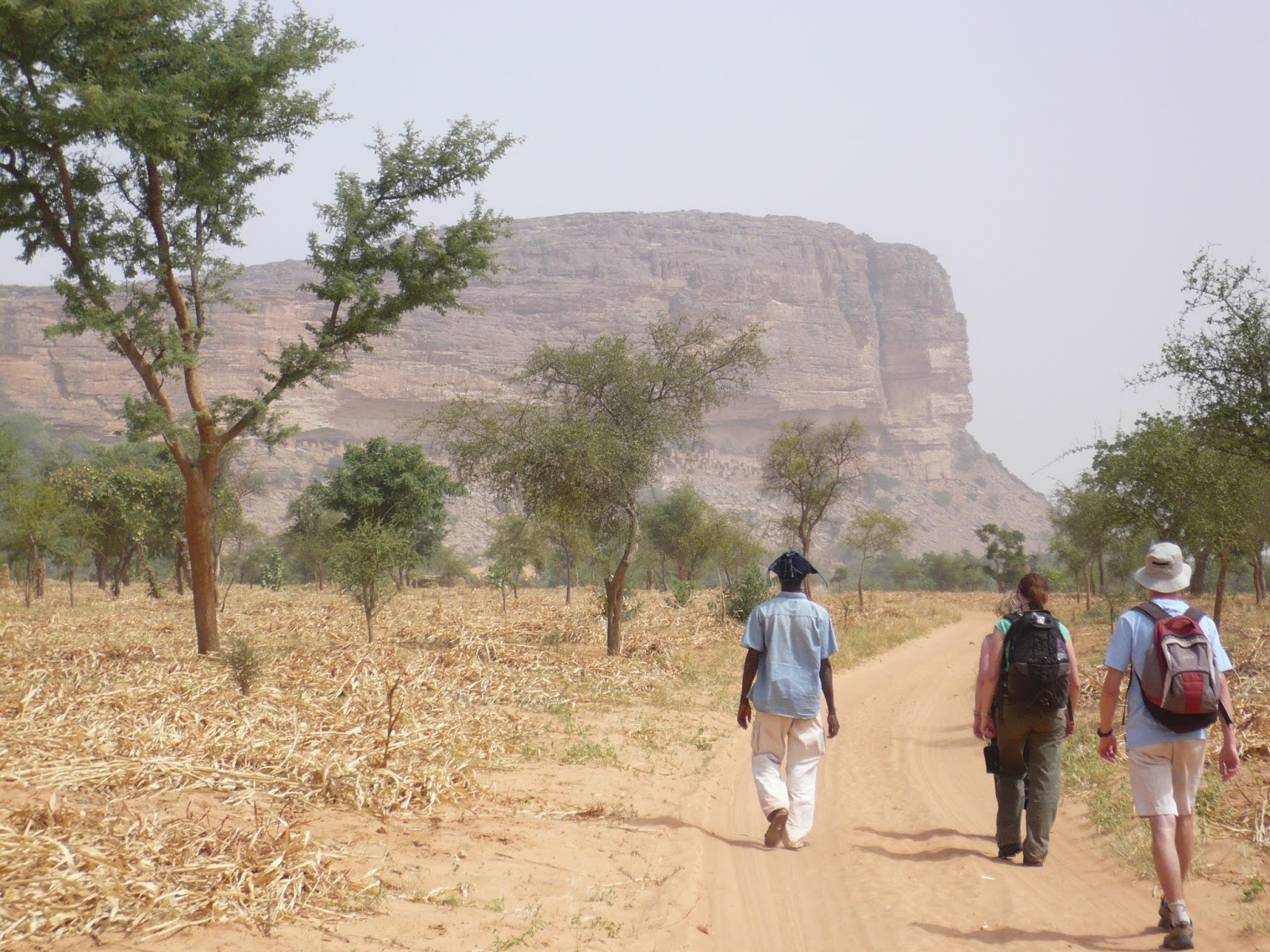
Hiking the escarpment

It's hard work!
Finally, one place that really blew my mind, and the undisputed highlight of any journey to West Africa (as long as the journey includes Mali of course) is the Dogon Escarpment, a long ridge in western Mali which is visually stunning, and a popular place to trek. I trekked along the bottom of the ridge for a day and a half, and then ascended to the top.

I stayed a night in a village at the bottom, where we met the locals and saw life continuing mostly as it has for centuries. However they do have car batteries which provide basic lighting in the evening. There was a cultural show as well, and for the sleeping element I was (with three friends) on the roof of a mudbrick building, sleeping under the stars. It was a perfect spot to sleep!

A Dogon Mosque, made from mud-brick.


The next day after the climb to the top we stayed at another village, and visited another meeting school children, craftsmen and a holy man. It was a completely unique experience and one I will always treasure and remember.


Dogon school room


For more information on Mali and the Dogon Escarpment, Please see my Chapter for Mali in the Dhaka to Dakar: Across Africa book.


These are just five amazing things I have seen. They are not necessarily my top five, or in a specific order, but I wanted to take the chance to blog about some of the brilliant things I’ve been so fortunate to see – and experience, in my travels. What are some of the brilliant places you’ve seen or visited?

Friday, February 28, 2014

T'riffic Tashkent

Hi all
a short extract from my latest ebook - Short Journeys: Kyrgyzstan and Uzbekistan.
I have been talking lately a bit about Kyrgyzstan, so here is a bit of information straight from the book about Tashkent, the Uzbek capital.

The book is available now for Kindle, and is only $1.39. Please support independent epublishing!


Tashkent

The Sleeping


.
Gulnara Bed & Breakfast. Single room, shared bathroom, breakfast. $20 (February 2014)
This is the place to stay for the budget traveller in Tashkent. They have all manner of rooms in buildings set around a nice courtyard, including dorms. It’s very popular and was full of people waiting for onward visas and the like when I was there. The room I had was really nice despite no private bathroom. Despite no air conditioning it was cool, quiet and had a comfortable bed. The place had simple cooking facilities and the people who stayed there were friendly and a good crowd.
It’s cheap, registration was simple, good family running the place, spacious. Ok, I don’t need to go on, a great place to stay, as were all my guesthouses in Uzbekistan.
On top of that, my first night in Uzbekistan and Tashkent I was taken in by a man I met on the taxi rides from Kazakhstan to Tashkent. He was really friendly and when I discovered the above guesthouse booked out for that night, he very kindly offered me a place to stay even though I had decided to go to a different hotel. He had a very well appointed apartment, but I will always remember the generosity.

Tashkent the city and the seeing

Tashkent is a much bigger city than Bishkek. More grandiose and wider than Almaty, it didn’t appear to be overpopulated, but it did appear to take up a fair amount of land. It was cooler than the other parts of the country that I visited thankfully, and has a selection of museums and again plenty of parks to keep the visitor amused for a couple of days at least.
Getting around it by taxi isn’t too expensive, and there is also a bristling metro which doesn’t yet cover the whole city, but if there’s a station close to where you want to go it’s the best deal around and well run. Be prepared to have your bags searched at metro stations coming in, Tashkent is pretty security conscious. The Metro in 2011 was 600 som for a trip.

History Museum of the Timurids (Entrance 3000 som)

You may not have heard of Timur, but for today’s Uzbekistan, he is the most important historical figure. The somewhat eccentric President of Uzbekistan, Karimov, has moulded modern Uzbekistan on the back invoking the memory of this Uzbek warrior, who lived 600 years ago and seems to be the Uzbek answer to Genghis Khan. Like Kazakhstan, since the breakup of the Soviet Union there were some dark years followed by a resources’ boom which has delivered financial stability to the country.
Timur has since become a symbol of pride for the Uzbek people, and Karimov has used his image to inspire the Uzbek people and increase national pride. So, they built a museum to Timur housed in an interesting domed building. The ceiling of the dome is particularly beautiful, and the circular building itself is impressive. A very fancy chandelier hangs from the centre of the dome, and the visitor is treated to all manner of images of Amir Timur.


The building is more interesting, sadly, than the contents of the museum which doesn’t have much in the way of English and is telling the story of Timur. You will find a quote there from President Islam Karimov –
‘Anyone who wants to understand who the Uzbeks are, if somebody wants to comprehend the power, might, justice and unlimited abilities of the Uzbek people, their contribution to global development, their belief in future, he should recall the image of Amir Timur.’ Yes, it probably doesn’t make a lot of sense. But there’s some passion there for you.

If you’re done with the museum but not done with Amir Timur, then opposite the museum is a huge square that is called the ‘Amir Timur Maydoni’, which I’d say means ‘Amir Timur Square’. Roads and paths seem to stretch out from it in most directions and the Hotel Uzbekistan stands very tall to one side. But in the centre you will find a very fine, tall statue of Timur himself taking his place in modern Tashkent. What more could you ask for?

.
For the record Timur lived somewhere between 600 and 700 years ago and was a bit of a blood thirsty tyrant. Still, using his image to shape modern Uzbekistan has appeared to be successful, you would have to say Karimov’s ideas for motivation have been a big hit.

The History Museum of the People of Uzbekistan (entrance – 4000 som)
If you’re looking for a more traditional museum with more interesting contents, then this one fits the bill. For historians and archaeologists there’s a lot here from different periods of history and regions, and if you like your pottery old and broken bowls, you’ll be well catered for too. I must confess I was more taken by the staff using the wide screen televisions which I presumed were meant to be showing informative videos to watch Turkish soaps. Not such a great look… But amusing nonetheless!
The third floor has more about modern Uzbekistan, future projects and of course parts devoted to the President, Karimov. One thing the region is not short of is leaders with healthy egos. Do note that strictly speaking you are supposed to pay extra to use a camera in the museums in Tashkent, and often in other places in Central Asia too. In fact a camera can often cost twice the regular ticket. Don’t be surprised about it. Museums are not always the best place for photos anyways.

Chorsu Bazaar

Next to the Chorsu Metro stop and not far from Gulnara B & B, the Chorsu Bazaar is housed under some impressive domes and has all manner of vegetables, fruit and meat that you’d expect to find in a bustling bazaar. Not only that, but outside the central bazaar are shops for jewellery, postcards and other sorts of souvenirs and the prices are pretty reasonable so if you are looking to do some shopping, then this might just be the place for you.

Holy Assumption Cathedral


This Orthodox Cathedral is proof that there are still a few Russians living in Uzbekistan. When I visited I found it a bit out of the way, so I had to take a taxi, the metro didn’t come close to the area. The taxis in Tashkent generally only cost $3-5 for a ride, so it’s not a huge strain on the wallet. They were in the middle of some renovations, and some sections had scaffolding, but it’s big and serene inside. It has lovely dome with a candle chandelier hanging from it. It also has numerous gold domes not just on the church but over the entrance gate as well. It was built in 1871 and was apparently the first Orthodox cathedral in Central Asia.

Navoi Park

Of all the parks in Central Asia, this simply was the finest. And the biggest, it seemed to go one for acres. In fact it very probably did. And still does. And you know the best thing about parks; they are almost always completely free.
There is a man-made lake in the park which was set up as a sort of makeshift beach, and in the sun and heat it was a hit. You can walk around for hours and relax. There were plenty of pools and fountains with kids escaping the heat without their parents having to pay for them to go into the ‘beach’ area. There were also amusement rides, restaurants and ice cream carts. Easy place to lose yourself in for an afternoon.


Kulkedash Medressa

.
Not far from the Chorsu Bazaar is the Kulkedash Medressa, well worth a visit. Although it has been restored many times (thanks to earthquakes) the medressa dates back to the 16th century. This would make it one of the older buildings (or at least the site) in Tashkent. It’s really beautiful and was abuzz with activity when I visited; it is still very much a place of learning. Inside the outer walls the courtyard is a well appointed garden, a little bit of paradise away from the outside hustle and bustle of Tashkent.